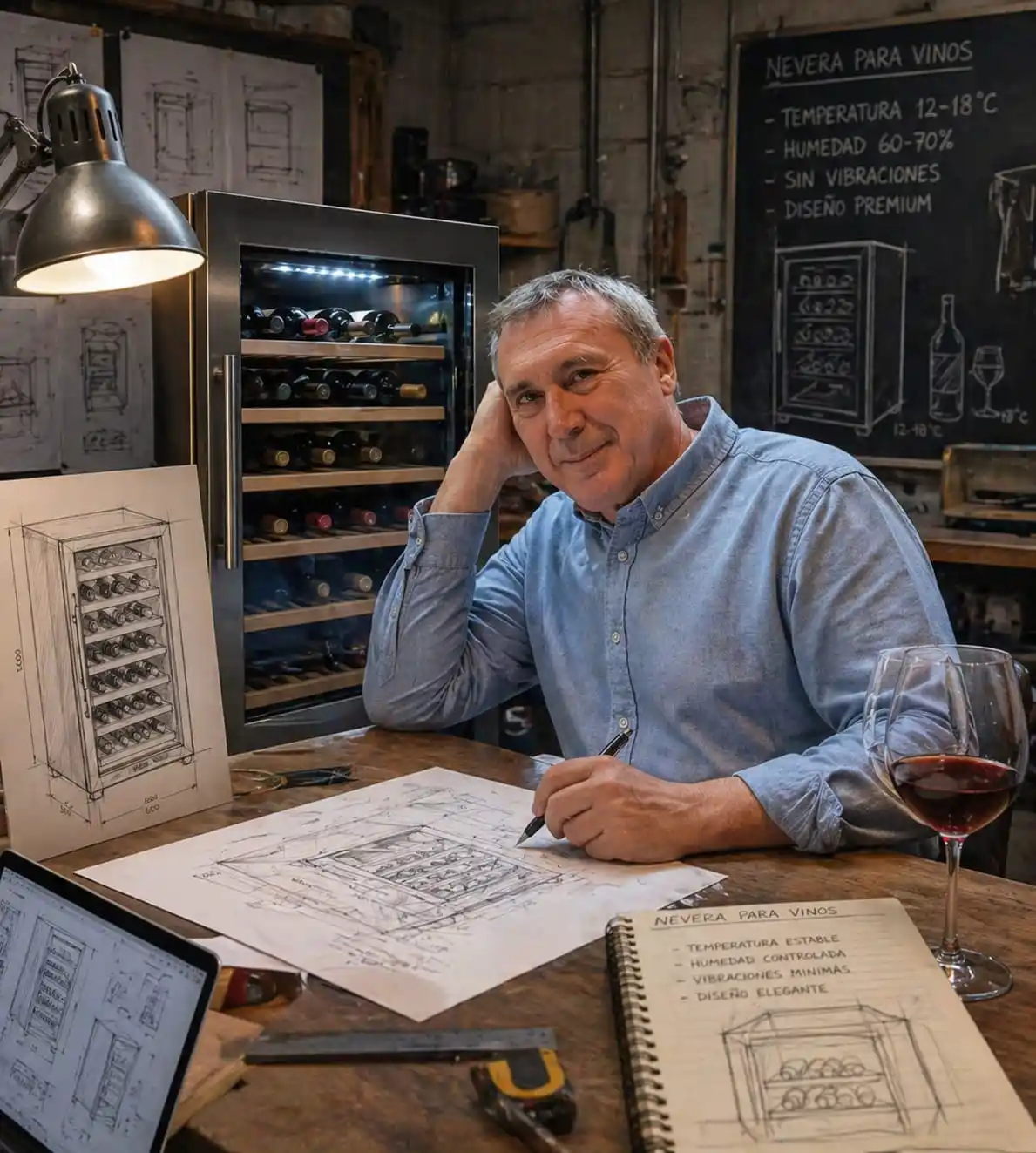
Red wine temperature is one of the most misunderstood questions in wine culture. The word «chambré», usually mistranslated as «room temperature», was coined in French châteaux whose interiors sat at 16-18 °C. In a modern home at 22-26 °C in summer, serving and storing red wine «at room temperature» means serving and storing it badly.
This guide separates the two questions that get mixed up: what temperature to serve at and what temperature to store at. Exact ranges by style, why stability matters more than the absolute figure, and how each solution controls it (fridge, off-the-shelf cabinet, dual-zone cabinet, bespoke climate-controlled cellar).
This piece belongs to our wine preservation cluster. For the full picture, see how to store wine in optimal conditions, which covers all five parameters (temperature, humidity, light, vibration and position) in detail.
1. Two questions: serving vs storage
The confusion starts by mixing two different things:
- Serving temperature: the temperature in the glass. It determines how the wine reads in the mouth: aromatics, tannin, alcohol.
- Storage temperature: the temperature the wine lives at between harvest and drinking, whether that is one day or twenty years. It determines how the wine evolves and how well it is preserved.
They are two different ranges. Storage is always cooler (12-14 °C) than serving (13-18 °C depending on style). Dual-zone cabinets and bespoke cellars manage both at once.
2. Serving temperature by style
Style, not price, sets the ideal serving temperature. This is the reference table we work with:
| Style | Examples | Serving |
|---|---|---|
| Light young reds | Beaujolais, fresh Garnacha, young Mencía | 13-15 °C |
| Fuller young reds | Young Ribera, young Toro, young Priorat | 15-16 °C |
| Crianza | Rioja crianza, Ribera crianza, Chianti Classico | 16-17 °C |
| Reserva | Rioja reserva, classic Bordeaux, Burgundy pinot | 17 °C |
| Gran reserva and powerful reds | Gran reserva, Châteauneuf, Brunello, Barolo | 17-18 °C |
| Fortified reds | Red Port, Banyuls, Maury | 15-17 °C |
By denomination of origin
The question usually arrives by denomination rather than by style, so here is the direct equivalence for the DOs we are asked about most, with the storage figure alongside:
| Denomination | Level | Serving | Storage |
|---|---|---|---|
| Rioja | Joven | 14-15 °C | 12-13 °C |
| Rioja | Crianza and reserva | 16-17 °C | 13-14 °C |
| Rioja | Gran reserva | 17-18 °C | 13-14 °C |
| Ribera del Duero | Joven and roble | 15-16 °C | 12-13 °C |
| Ribera del Duero | Crianza upwards | 17-18 °C | 13-14 °C |
| Priorat and Toro | All | 17-18 °C | 13-14 °C |
| Bierzo and red Rías Baixas | All | 13-15 °C | 11-12 °C |
| Red Rueda | All | 15-16 °C | 12-13 °C |
| Beaujolais and light reds | All | 13-14 °C | 11-12 °C |
| Merlot, Côtes-du-Rhône | Medium bodied | 15-16 °C | 12-13 °C |
| Cabernet, Syrah, Malbec | Full bodied | 17-18 °C | 13-14 °C |
The storage column is not the serving column: it is the temperature the bottle should live at while it waits, always 3-4 °C below the serving figure and, above all, constant.
A pocket rule if you would rather not consult tables: the more structure and barrel a wine has, the warmer it is served, and no red ever goes above 18 °C.
What should I set my wine cabinet to?
Two different things get mixed here. If the cabinet is single-zone and you use it for storage, set it to 12-14 °C: that is a storage temperature, not a serving one, and taking the bottle out twenty minutes early is enough. If it is dual-zone, the lower zone goes to 12-14 °C for ageing and the upper zone to 16-17 °C, which is already a serving temperature and lets you open a bottle without waiting.
The usual mistake is setting the whole cabinet to 17 °C because that is drinking temperature. At that setting the wine evolves considerably faster than it should, and after two or three years it shows in the bottles meant for ageing.
Why young wines are served cooler
Young wines live on fresh fruit and acidity. Cooler temperatures lift both and soften the sense of alcohol. Serving a Beaujolais at 18 °C turns it into another wine: the alcohol shows, the fruit steps back and small flaws become obvious.
Why gran reservas are served warmer
Reserva and gran reserva wines have complex tannic structure and tertiary aromatics (leather, spice, forest floor) that need warmth to open. At 14 °C a classic Bordeaux reads closed and rough; at 17 °C it opens, the tannins integrate and the evolved aromas emerge.
3. Storage temperature: a constant 12-14 °C
For medium and long-term storage, the ideal temperature is 12-14 °C with a maximum swing of ±0.5 °C. That is the historic figure of the great Bordeaux chais and the one we apply in every climate-controlled cellar we design.
Why 12-14 °C and not anything else
The range balances three requirements:
- Rate of evolution. Below 10 °C evolution slows so much that the wine takes decades to show; above 16 °C it accelerates so much that freshness is gone in a few years. 12-14 °C is the right speed.
- Cork stability. At 12-14 °C the cork keeps its elasticity without expanding cycles. Below 8 °C relative humidity drops under 60 % and the cork dries out; above 18 °C the cork expands and contracts repeatedly.
- Energy efficiency. In a Mediterranean climate, 12-14 °C is achievable at reasonable running costs. Going down to 10 °C doubles the energy bill and demands more capable refrigeration.
Whites and sparkling wines: 10-12 °C
If your collection is mixed, the professional answer is a single-zone climate-controlled cellar at 12 °C. Whites and sparkling wines keep perfectly well there (technically they prefer 10-12 °C but tolerate 12 °C without issue). For service, they move to a serving compartment at 8-10 °C in the hours beforehand.
4. The «chambré» mistake
«Serve a red chambré» was good advice when it was said in a nineteenth-century French château. Those houses had interiors at 16-18 °C even in summer: metre-thick stone walls, no central heating, small windows. «Chambré» meant «bring it to room temperature», and that room temperature happened to be the ideal serving temperature for a Bordeaux.
Taken literally today it is simply wrong
A typical modern home sits at 24-26 °C in summer and 20-22 °C in winter with the heating on. Serving a red «at room temperature» in those conditions means serving it at 22-26 °C, a temperature where the wine loses freshness, the alcohol turns aggressive, the aromatics flatten and the tannins feel drying.
«Serving a Rioja gran reserva at 24 °C in a city flat is serving a different wine. A worse one, but a different one.»
The practical rule
Whenever in doubt, serve the red 3-4 °C cooler than your instinct says. If it feels «too cold» at first, wait ten minutes: it will rise into the right range on its own. The opposite mistake, serving a red at 22-26 °C because «that feels right», is practically irreversible: cooling a wine once it is in the glass is slow and ineffective.
5. Why swings are worse than heat
A wine kept at a constant 16 °C ages better than one kept at 14 °C that climbs to 22 °C every summer. The reason is physical:
Cork movement
Wine expands about 0.1 % per °C. Every warming cycle pushes the cork outwards and expels air from the neck; every cooling cycle draws outside air back in. The cork loses elasticity with each cycle, becomes permeable to oxygen and the wine oxidises prematurely.
Non-linear chemistry
Following Van't Hoff applied to oenology, roughly every 10 °C doubles the speed of the chemical reactions inside the bottle. A 24 °C spike for 30 days in summer ages the wine the equivalent of an extra 6-8 months. Peaks matter more than averages.
Aromatic stratification
Volatile aromatics reorganise with every thermal change. Wines put through repeated thermal cycles lose aromatic complexity even when the average temperature is correct.
This is why underground wine cellars are the best answer for serious ageing collections: they use the thermal inertia of the ground and hold ±0.2-0.3 °C across the year with almost no mechanical effort.
6. Solutions: fridge, cabinet, cellar
Domestic fridge → no
For storage beyond a few days: it does not work. Too cold (2-5 °C), too dry (35-40 % RH), constant compressor vibration, light every time it opens. Only acceptable for chilling a bottle a few hours before serving.
Entry-level single-zone cabinet → occasional use
Basic models: €100-500. Adjustable between 5 and 18 °C, humidity unregulated. Acceptable for drinking collections of up to 50-100 bottles with fast rotation. Not for ageing.
Dual-temperature cabinet → the domestic answer
Professional models (EuroCave, La Sommelière premium, upper-range Climadiff): €1,500-4,500. Two independent zones: lower at 14 °C for red crianza and reserva, upper at 10-12 °C for whites and sparkling. Regulated humidity, typically 100-300 bottles. For active domestic use with a mixed collection.
Bespoke wine cabinet → integration plus engineering
When you want architectural integration with the kitchen or living room, or capacity beyond 300 bottles. Built-in kitchen wine cabinets (if the idea is to build it into the units, read how to integrate a wine cabinet into the kitchen first) and glass wine rooms for living areas: bespoke dual zones, noble materials and climate control within ±0.5 °C.
Climate-controlled or underground cellar → serious storage
For collections of 500 bottles and up, especially with long-ageing wines: an underground cellar using the ground's thermal inertia plus support climate control. Stability of ±0.3 °C, active humidity, professional anti-vibration, capacities from 1,000 to 8,000 bottles.
7. Getting from storage to serving
If you store at 12-14 °C and want to serve at 17 °C, you need a transition. Three correct methods:
- Natural anticipation (recommended). Take the bottle out 60-90 minutes before serving. At normal room temperature it will gain the 3-4 °C needed.
- Dual-zone cabinet. The upper zone at 16-18 °C holds the bottle you are about to serve during the hours beforehand. The elegant solution for regular use.
- Decanting plus waiting. If the bottle is too cold and there is no time, decant it: aeration and the larger surface speed up warming. It gains 2-3 °C in 25-30 minutes.
What does not work: microwaving or oven-warming a cold bottle (uneven heating plus pressure risk). What you should never do: chilling a very warm bottle in the freezer, because the wine can freeze and break the glass.
Frequently asked questions
What temperature should red wine be served at?
Light young reds: 13-15 °C. Fuller young reds: 15-16 °C. Crianza and reserva: 16-17 °C. Gran reserva and powerful reds: 17-18 °C. Above 19 °C the alcohol turns aggressive and the wine loses freshness.
What temperature should red wine be stored at?
12-14 °C with a maximum swing of ±0.5 °C. Stability matters more than the absolute figure: a wine at a constant 14 °C ages better than one swinging between 12 and 18 °C every summer.
Why is red wine not served at room temperature?
Because modern room temperature (22-26 °C) is too warm. The «chambré» rule was coined in French interiors at 16-18 °C. At 24 °C the alcohol dominates, the tannins turn drying and the aromatics disappear.
What happens if I store red wine at 22 °C?
It ages far too fast. At a constant 22 °C a crianza loses freshness in 2-3 years; at 26 °C, in a single season. Swings make it worse: the cork expands and contracts with every cycle and lets oxygen through.
Can red wine be stored in a normal fridge?
Not beyond a few days. A fridge runs at 2-5 °C with 35-40 % humidity, too cold and too dry. The compressor vibrates constantly and light hits the bottles at every opening. For longer than a few weeks you need a wine cabinet or a climate-controlled cellar.
What is the difference between serving and storage temperature?
Storage: where the wine lives for years (12-14 °C). Serving: where it is drunk (13-18 °C by style). The gap is handled by taking the bottle out early, or with a dual-zone cabinet.
Do dual-temperature cabinets work for both storing and serving?
Yes, the most practical solution for active domestic use. Lower zone at 14 °C for red crianza; upper zone at 10-12 °C for whites and sparkling. Enough up to 150-300 bottles. Beyond that, a single-zone climate-controlled cellar.
How long does a cold red take to reach serving temperature?
A bottle at 12 °C reaches 16-17 °C in 45-90 minutes in a 20 °C room. Faster in a 24 °C room (30-45 min), slower at 17-18 °C (90-120 min).
AI-assisted draft, reviewed and approved by Juan Serrate on . How we make our content
Thinking about a bespoke cellar or wine cabinet?
We design built-in cabinets, glass wine rooms and underground cellars with ±0.5 °C stability, active humidity and professional anti-vibration. Free technical site visit, 3D render before manufacture.